Wilmington, DE, United States, Sept. 09, 2026 (GLOBE NEWSWIRE) -- Digital Substation Market Emerging as the Operational Backbone of Modern Power Infrastructure
The conversation around grid modernization has shifted. For years it centered on adding capacity, building more lines, more transformers, more physical hardware. That framing is now outdated. The decisive constraint has moved from steel and copper to data, control architecture, and the ability to operate substations as intelligent nodes rather than passive switching points. The digital substation market sits exactly at this inflection.
What looks like a slow utility procurement cycle is, underneath, a reordering of who controls grid flexibility. Renewable developers, data center operators, and rail electrification programs are competing for the same scarce thing, namely substations capable of handling bidirectional flows and millisecond-level protection. Utilities that treat digitalization as a strategic asset rather than a procurement step are pulling ahead, and the gap between those two postures is widening each quarter.
Request a Free Sample Report: https://marketmindsadvisory.com/request-sample/?report_id=5411
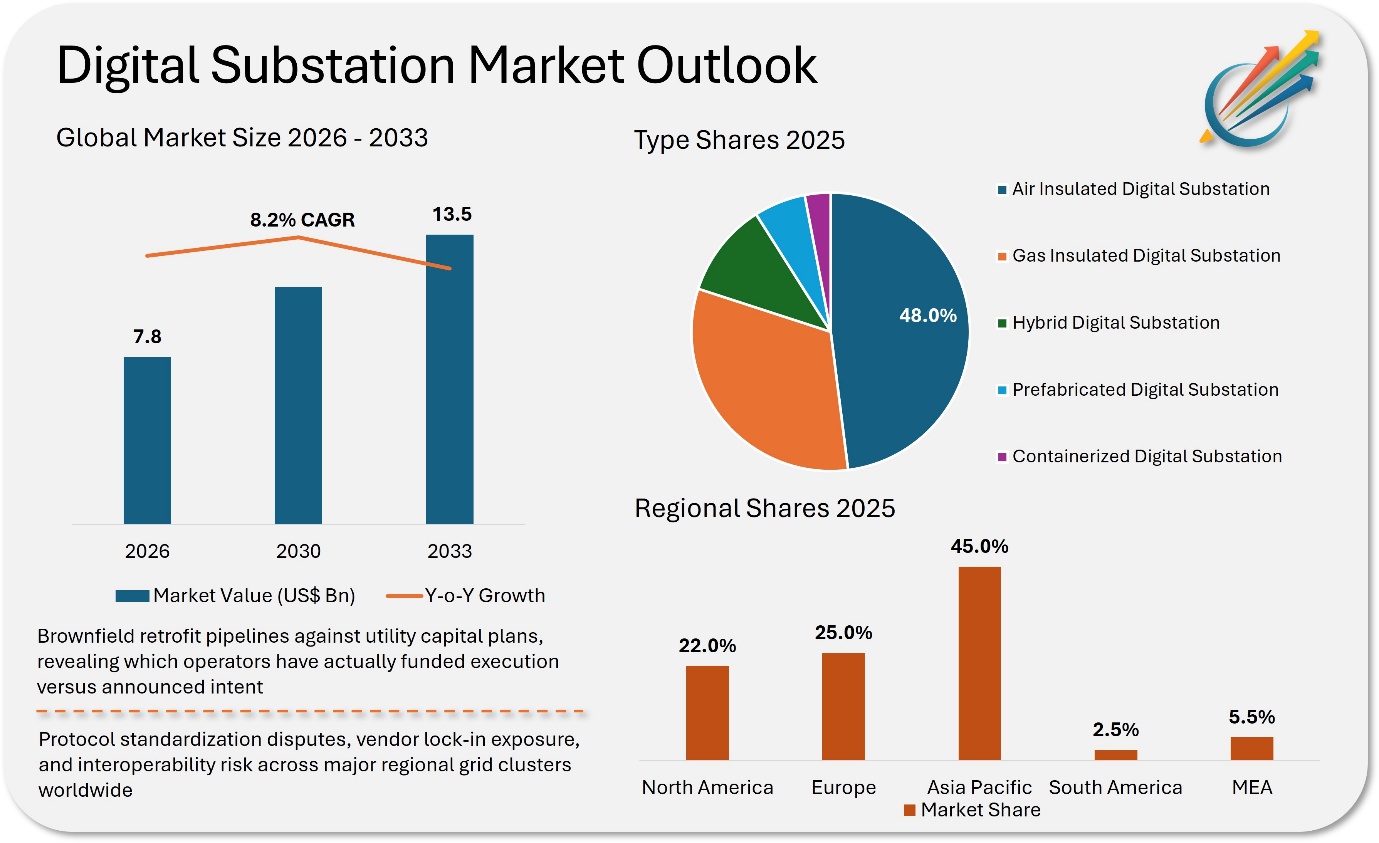
Key Takeaways from Digital Substation Market
- The digital substation market is valued at US$ 7.8 billion in 2026, anchored by transmission-side modernization demand and is projected to reach US$ 13.5 billion by 2033, reflecting a sustained replacement and retrofit cycle.
- Brownfield retrofit activity is rising faster than greenfield as aging assets reach end of service life in the digital substation market.
- Renewable integration is the fastest-expanding application as variable generation strains legacy protection schemes.
- Gas insulated configurations dominate space-constrained urban and industrial deployments in the digital substation market.
- Data center power infrastructure has emerged as a credible new demand pillar for high-reliability digital substation market.
As per Senior Consultant from Market Minds Advisory, "Most utilities still budget digital substations as incremental upgrades, which understates the strategic stakes. The operators securing engineering capacity and standardized architectures over the next four to six quarters will set the cost and reliability terms that competitors spend the following decade trying to match."
Operators Securing Digital Architecture and Engineering Capacity Early are Locking Long-Term Advantage
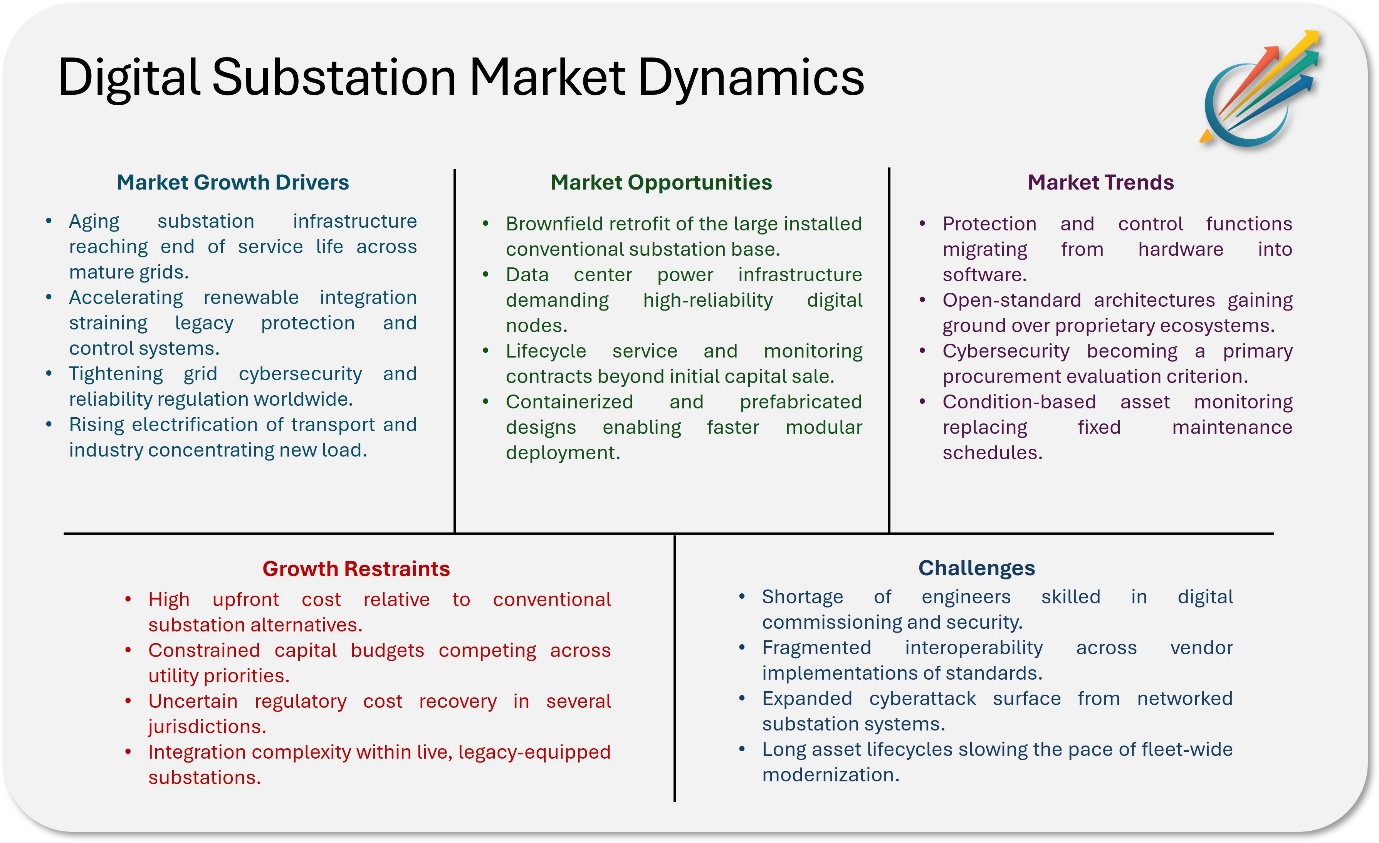
The window for shaping substation architecture is narrower than most capital planning cycles assume. Decisions made now lock in protocol choices, vendor relationships, and cost structures for two decades.
- Aging assets are forcing the timeline: A large share of installed substations are approaching end of life simultaneously, compressing replacement decisions into a tight band where engineering and supply capacity is already constrained.
- Standardization is hardening early: IEC 61850 implementation choices made today determine future interoperability. Operators locking in proprietary variants now will face costly migration later.
- Skilled engineering capacity is the binding constraint: The pool of engineers fluent in digital substation commissioning is limited, and early movers are securing that talent through long-cycle contracts.
Digital Substations Quietly Shifting from Equipment Procurement to Strategic Architecture Decisions
The most consequential change in this sector is not technological in the digital substation market. It is the redefinition of what a substation purchase actually is. Buyers are moving from component sourcing to system architecture commitment.
- Protection and control are decoupling from physical hardware: Functions once embedded in dedicated devices now run as software on standardized platforms, shifting differentiation toward firmware, cybersecurity, and lifecycle support rather than the switchgear itself.
- Interoperability is becoming a procurement weapon: Utilities that specify open standards retain negotiating leverage across refresh cycles, while those accepting closed ecosystems surrender pricing power for the asset's entire service life.
- The vendor relationship is lengthening: Digital substations require continuous patching, monitoring, and upgrades, turning a one-time capital sale into a multi-decade service dependency that reshapes how both sides assess value.
Grid Modernization Strategies Still Underestimate the Speed of Structural Change
Brownfield retrofit, not greenfield construction, will drive the majority of digital substation market value through 2033. Consensus attention favors new builds, but the installed base of aging conventional substations represents a far larger and more urgent addressable opportunity that retrofit-capable vendors are better positioned to capture.
Cybersecurity, not protection speed, becomes the primary buying criterion. As substations become networked software systems, the attack surface expands sharply. Procurement teams that still rank vendors on traditional electrical performance are evaluating against the wrong scorecard.
Data center operators will exert disproportionate influence on product roadmaps. Their reliability requirements and willingness to pay premiums are pulling vendor development priorities away from traditional utility specifications, quietly reshaping what the standard digital substation looks like.
New Competitive Structure is Forming Across the Digital Grid Ecosystem
Renewable variability demands faster grid intelligence
Variable solar and wind generation overwhelms protection schemes designed for predictable one-directional flow. Digital substations provide the sensing and adaptive control that variable resources require, creating a direct mechanical link between renewable expansion and substation digitalization. Developers increasingly find that grid connection terms, not turbine availability, gate their project timelines, which pushes substation intelligence to the center of project economics.
Grid decentralization rewrites control requirements
Power systems are shifting from a few large plants toward distributed generation, storage, and flexible loads. This decentralization multiplies the number of control points the grid must coordinate in real time. Digital substations function as the intelligent nodes that make distributed coordination possible, and utilities that delayed digitalization are now discovering their control architecture cannot accommodate the resources regulators expect them to integrate.
Electrification of transport and industry concentrates load
Rail electrification, electric vehicle charging corridors, and industrial decarbonization are creating dense new load pockets. These loads need substations with precise monitoring and rapid fault isolation to maintain reliability. The digital substation market benefits directly as operators upgrade nodes that suddenly carry critical, concentrated demand they were never originally engineered to serve.
Cybersecurity regulation forces architectural change
Tightening grid security mandates across major economies are making certain legacy configurations non-compliant. Compliance now requires designed-in segmentation, monitoring, and access control rather than retrofitted patches. This regulatory pressure converts digital substation adoption from a discretionary efficiency play into a mandated upgrade, accelerating timelines that financial justification alone would have left slower.
Execution Bottlenecks and Regulatory Complexity Could Reshape Deployment Timelines
- Capital allocation pressure: Utility budgets face competing demands from generation, lines, and storage, and digital substation spend can be deferred when rate cases tighten.
- Cybersecurity exposure: Networked substations expand the attack surface, and a high-profile breach could slow adoption or trigger restrictive regulation.
- Interoperability fragmentation: Inconsistent IEC 61850 implementations create integration friction and raise the cost of mixing vendors across a fleet.
- Skilled workforce shortage: A limited pool of commissioning and cybersecurity engineers constrains how fast operators can deploy, regardless of capital availability.
- Legacy integration complexity: Brownfield retrofits must interface with decades-old equipment, introducing schedule risk and unexpected cost in live substations.
- Regulatory cost recovery uncertainty: Where regulators hesitate to approve digitalization costs in rate bases, utilities lack a clear return justification.
None of these headwinds reverses the directional conclusion. They shape the pace and sequencing of deployment rather than the destination, and operators that plan for them retain the timing advantage.
Market Dynamics Shaping the Digital Substation Market
Digital Substation Market Segmentation
By Type
- Air Insulated Digital Substation
- Gas Insulated Digital Substation
- Hybrid Digital Substation
- Prefabricated Digital Substation
- Containerized Digital Substation
Gas insulated configurations hold strong share where land is scarce and environmental exposure is severe, particularly in dense urban and coastal industrial settings. Air insulated designs remain common where space permits and cost sensitivity is high. Prefabricated and containerized formats are gaining traction because they compress installation timelines and shift work to controlled factory environments. The digital substation market increasingly rewards designs that reduce on-site commissioning effort.
By Installation Type
- Greenfield Installation
- Transmission Substations
- Distribution Substations
- Brownfield Retrofit
- Transmission Substations
- Distribution Substations
Brownfield retrofit is the larger and more urgent opportunity, driven by an installed base of conventional substations nearing obsolescence in the digital substation market. Greenfield installation tracks new generation, electrification corridors, and grid expansion. Transmission-side projects carry higher value per node, while distribution-side activity is larger in volume. Retrofit work is technically harder, which favors vendors with proven integration capability in live environments.
By Voltage
- Low Voltage (Upto 230 kV)
- Medium Voltage (230 kV to 550 kV)
- High Voltage (Above 550 kV)
High voltage nodes anchor transmission backbones and attract the earliest digitalization investment because failure consequences are severe. Medium voltage sits at the renewable interconnection layer, where most variable generation actually connects, making it a fast-growing focus. Low voltage activity is broad and distribution-centric. Investment logic in the digital substation market follows criticality, with the highest-consequence nodes upgraded first.
By Application
- Power Transmission & Distribution
- Renewable Integration
- Industrial Power Distribution
- Utility Grid Modernization
- HVDC Converter
- Railway Electrification
- Data Center Power Infrastructure
- Others
Power transmission and distribution remains the core application by scale in the digital substation market. Renewable integration is the fastest-expanding use case as variable resources strain legacy systems. Data center power infrastructure has emerged as a high-value niche with stringent reliability demands. Railway electrification and HVDC converter applications add specialized, technically demanding pockets of growth that reward vendor depth.
By End User
- Transmission Utilities
- Distribution Utilities
- Independent Power Producers
- Renewable Energy Developers
- Heavy Industries and Manufacturing Plants
- Mining Companies
- Oil and Gas Companies
- Rail and Metro Operators
- Data Center Operators
Transmission and distribution utilities represent the dominant buyer group, shaped by regulatory mandates and reliability obligations across digital substation market. Renewable energy developers are an increasingly influential segment because grid connection quality directly affects their project returns. Data center operators, though smaller in count, exert outsized influence on product specifications through their reliability requirements and procurement budgets.
Shape this report around your priorities: https://marketmindsadvisory.com/request-customization/?report_id=5411
Regional Market Outlook
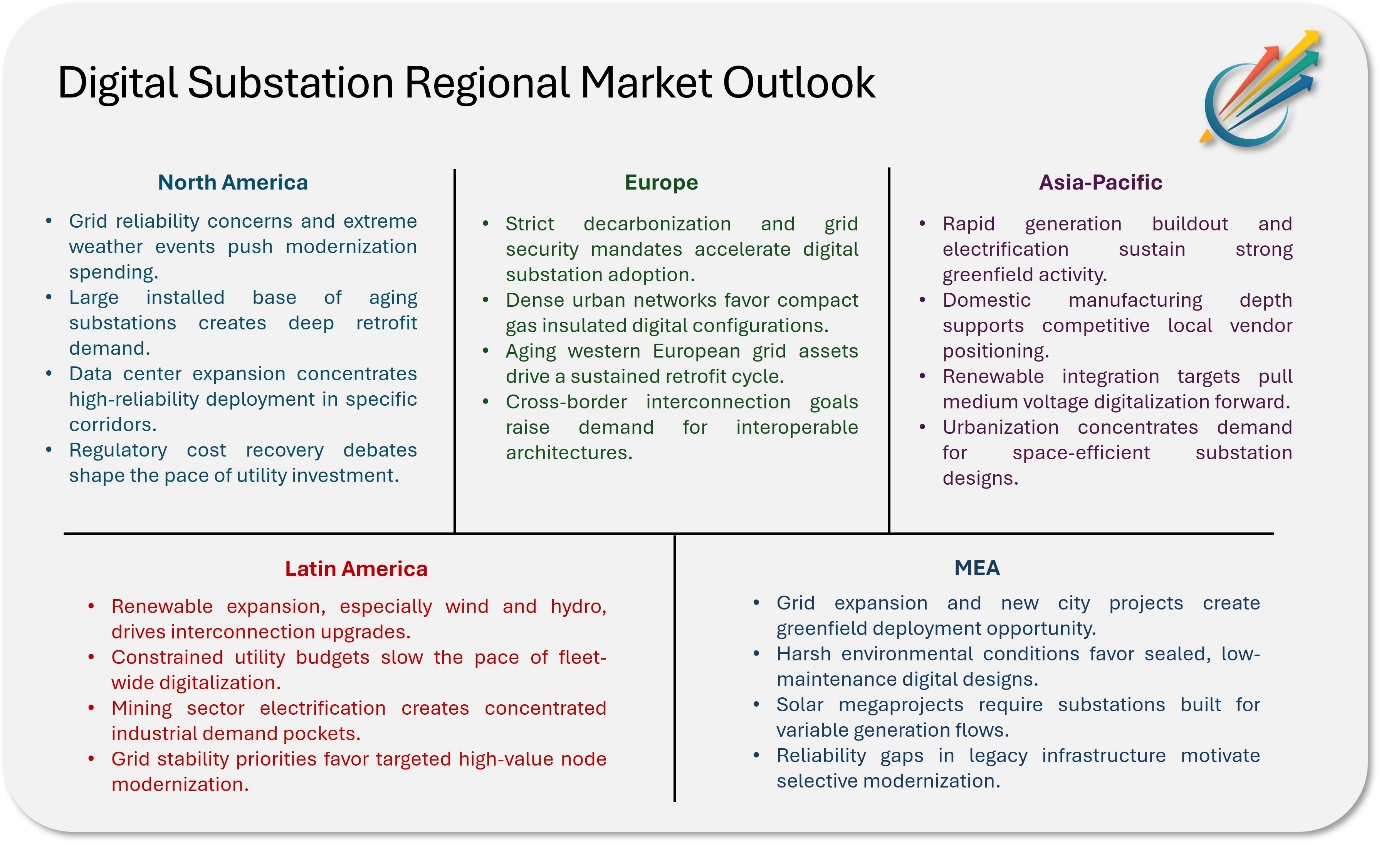
Investment Focus where the Lucrative Opportunity is Anticipated
Brownfield retrofit integration capability
The largest pool of addressable value sits in upgrading the existing conventional substation fleet. Vendors and engineering firms that can execute retrofits inside live substations, with minimal outage windows, hold a structurally advantaged position in the digital substation market that pure greenfield specialists cannot easily replicate.
Cybersecurity and lifecycle services
As substations become networked systems, recurring revenue from monitoring, patching, and security services compounds. This is a more defensible position than one-time hardware sales, because it deepens customer dependency and rewards the incumbents who designed the original architecture.
Data center power infrastructure
The reliability premiums data center operators pay make this the most attractive demand pocket within the digital substation market. Vendors that tailor protection speed and redundancy to hyperscale requirements capture margin that conventional utility procurement rarely allows.
Renewable interconnection at medium voltage
Most variable generation connects at the medium voltage layer, making it the highest-growth interconnection tier. Suppliers positioned at this renewable-to-grid interface capture value tied directly to the pace of clean energy buildout, an opportunity neither pure renewable nor pure grid vendors fully access.
What This Means for Decision-Makers
Energy Utilities - Treat substation architecture as a long-horizon strategic commitment, not a procurement line item. The protocol and vendor choices made over the next two years will set reliability and cost terms for two decades, and deferring decisions surrenders negotiating leverage.
Renewable Developers - Grid connection quality increasingly gates project returns. Engaging early on interconnection substation design, rather than treating it as a downstream utility responsibility, protects timelines and improves the economics of the digital substation market exposure embedded in your portfolio.
Investors - The defensible value has shifted toward retrofit integration capability and recurring lifecycle services. These positions offer clearer risk-return profiles than pure hardware exposure within the digital substation market, with revenue durability that one-time equipment sales cannot match.
Technology & Equipment Suppliers - Differentiation is moving from electrical performance to cybersecurity, interoperability, and lifecycle support. Suppliers that standardize on open architectures and build service depth will hold pricing power as the relationship shifts from transaction to multi-decade dependency.
Competitive Landscape: Digital Substation Market
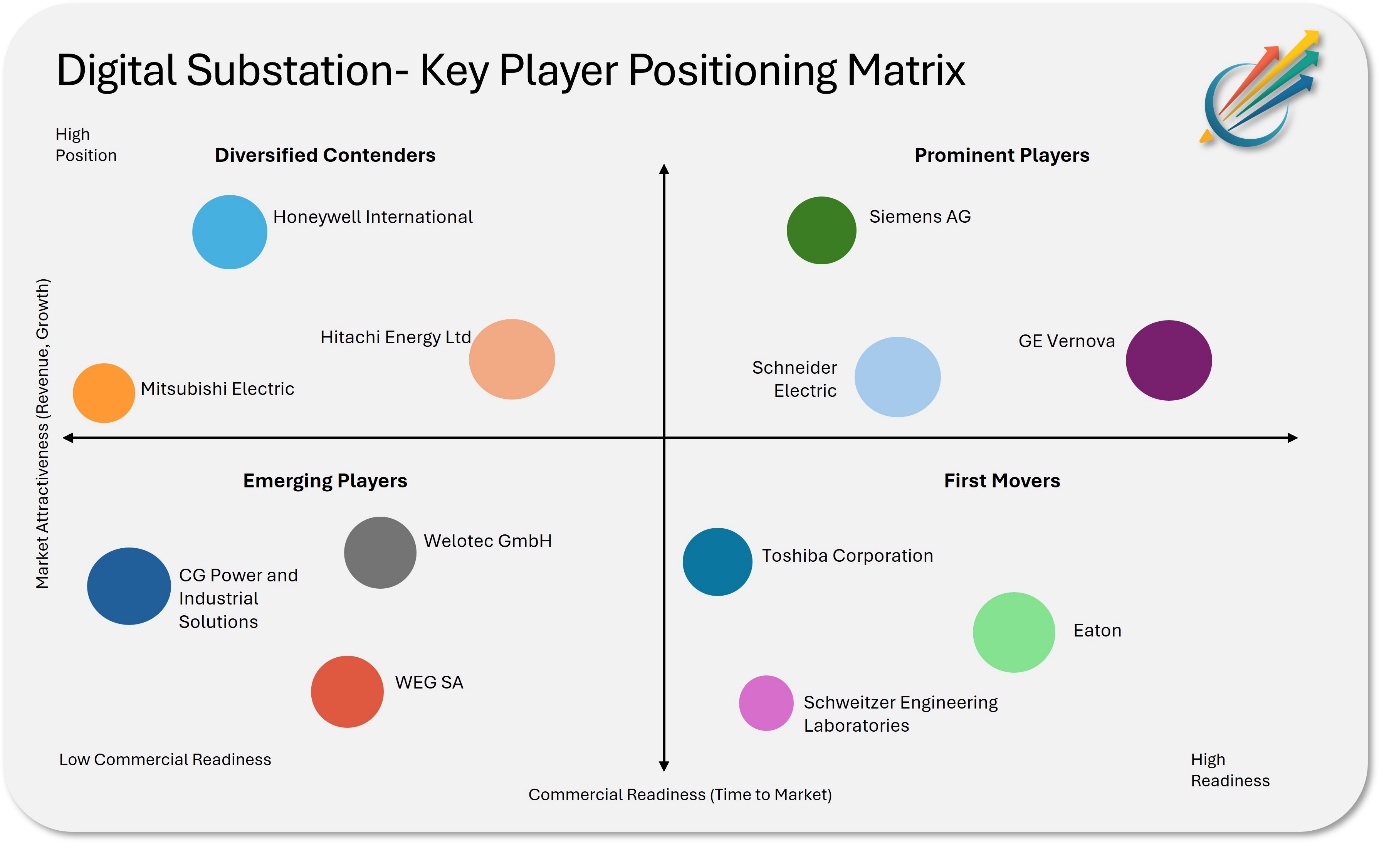
Recent Market Developments
- In April 2026, Hitachi Energy Ltd expanded its digital grid product portfolio to address rising demand for substation automation and protection systems.
- In March 2026, Siemens AG advanced its grid software and digital substation offerings as part of its broader grid technology strategy.
- In February 2026, GE Vernova continued positioning its electrification and grid automation business around digital substation and grid modernization demand.
- In January 2026, Schneider Electric reinforced its focus on grid digitalization and substation automation within its energy management segment.
Market is segmented by Type (air insulated, gas insulated, hybrid), Installation Type (greenfield, brownfield), Voltage (low, medium, high), and Application (power transmission and distribution, renewable integration, grid modernization, etc)
Get Access to complete Analysis, Buy Now: https://marketmindsadvisory.com/buy-now/?report_id=5411
Trending Reports
- Petroleum Liquid Feedstock Market
- PEM Fuel Cell Market
- Peak Shaving Construction Generator Sets Market
- PDC Drill Bit Cutters Market
- Overhead Conductor Market
- Partial Oxidation Blue Hydrogen Market
- Outdoor Boundary Vacuum Load Switch Market
- Organic Rankine Cycle Market
- Oriented Perforating System Market
- Open Transition Transfer Switch Market
Why choose Market Minds Advisory
Market Minds Advisory delivers decision-grade intelligence to executives across machinery, packaging, chemicals, automotive, ICT, food and beverage, consumer goods, and healthcare. We help organizations sharpen market expansion strategies, accelerate share gains, refine brand positioning, and enable account-level growth. Our forecasting integrates primary interviews, proprietary demand models, and continuous market validation, producing the kind of clarity volatile and emerging industries require. Backed by over a decade of sector expertise, our research surfaces white space, opportunity gaps, and competitive blind spots, accounting for recent developments and geopolitical risk. We help businesses see the future of their markets.
Contact Us
Market Minds Advisory
1521 Concord Pike, Suite 301
Wilmington, DE 19803
United States
Email: sales@marketmindsadvisory.com
Website: https://marketmindsadvisory.com/